


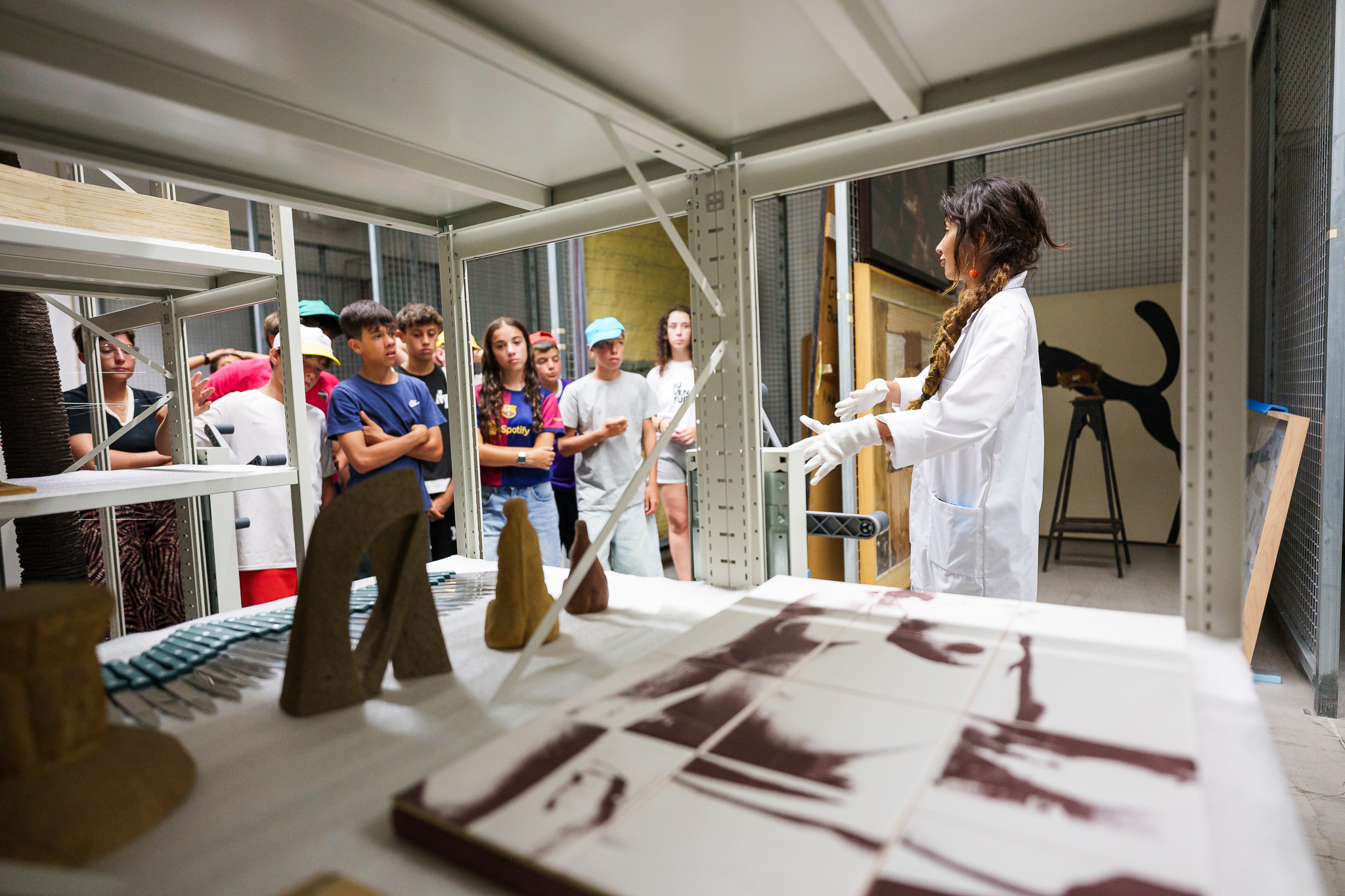
Following the reorganisation of the museum storage facilities of the Cerveira Biennial Museum, a programme of guided visits was developed with the aim of opening this space to different audiences and fostering a closer relationship between the collection, the institution, and its visitors.
Traditionally understood as a restricted and functional area, museum storage is here reconfigured as a space of visibility, knowledge, and encounter. These guided visits propose a shift in perspective, allowing the public to access the “behind the scenes” of museum practice and to engage directly with the processes of conservation, documentation and care that sustain the collection over time.
The visits are structured as a mediated experience, combining technical explanation with a more reflective and sensorial approach. Visitors are invited not only to understand the practical aspects of storage organisation and preventive conservation, but also to consider the broader implications of preserving contemporary art, its material fragilities, its conceptual challenges, and its relationship to time.













PARTICULAR EMPHASIS IS PLACED ON THE DIVERSITY OF THE COLLECTION, HIGHLIGHTING THE RANGE OF MATERIALS, TECHNIQUES, AND ARTISTIC LANGUAGES PRESENT IN THE STORAGE.










This diversity becomes a starting point for discussing the complexity of conservation strategies and the need for adaptable, context-specific approaches.
Beyond its informativa dimension, the guided tours is conceived as a space of attentiveness. By slowing down the pace of observation and encouraging proximity to the artworks, it creates conditions for a different kind of engagement, one that values detail, process, and the often invisible work of preservation.



In this context, museum storage is no longer perceived solely as a place of accumulation, but as an active environment shaped by care, decision-making, and continuous transformation. The guided visits thus contribute to redefining the role of storage within the museum, positioning it as a dynamic space of research, responsibility, and shared knowledge.
This diversity becomes a starting point for discussing the complexity of conservation strategies and the need for adaptable, context-specific approaches.
Beyond its informative dimension, the guided tours is conceived as a space of attentiveness. By slowing down the pace of observation and encouraging proximity to the artworks, it creates conditions for a different kind of engagement, one that values detail, process, and the often invisible work of preservation.
















The guided visits are designed for a wide range of audiences, from early childhood groups too university classes and curatorial or professional teams. They are adapted according to the specific profile and needs of each group, ensuring both accessibility and depth of engagement.
All visits are scheduled in advance, as they must be conducted by a specialised technician and coordinated with the museum’s daily operations, including exhibition installation, conservation treatments, and other technical activities.
To ensure both the quality of the experience and the preservation of the collection, larger groups are divided and admitted in phases, with a maximum of 20 participantes per group. This approach allows for careful control of the environmental conditions within the storage space, particularly in relation to relative humidity and temperature, which are continuously monitored as part of the museum’s preventive conservation strategy.


Photo credits: Cerveira Art Biennial Foundation (FBAC).
Leave a Reply